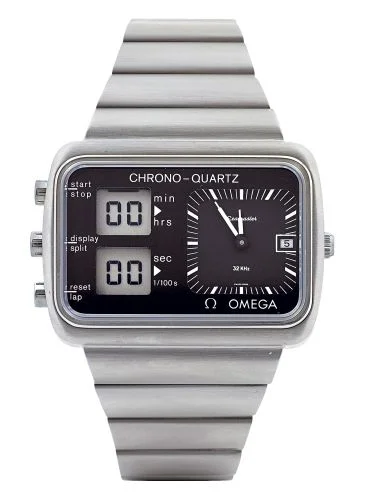
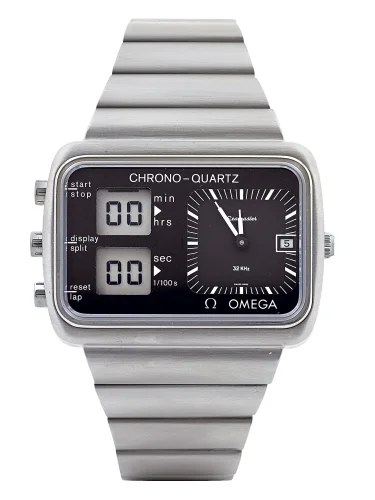
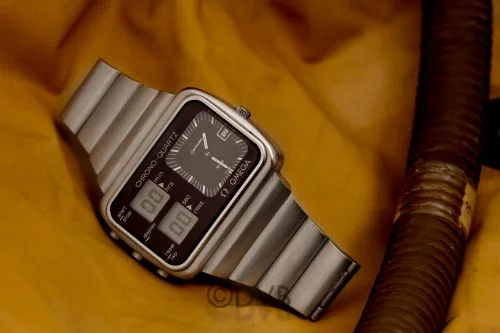
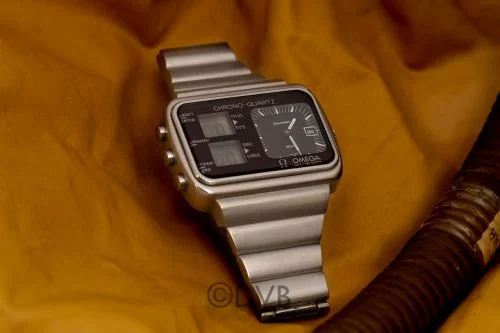

Seamaster Chrono-Quartz
REF. 196.00.52
8/10
Very rareCase
Dial
In Context
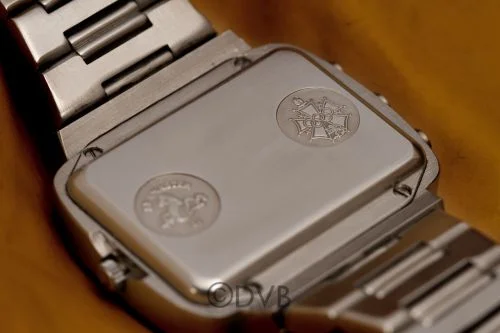
At 51.3 mm this is exceptionally large for something worn on a wrist, closer to a pocket watch given lugs. The case back is closed, so the movement stays out of sight, and the mineral crystal sits between the two — harder to scratch than plexiglass, easier to chip than sapphire.
It is quartz, so it will hold time far more closely than any mechanical watch here, and asks for a battery every few years rather than a service.
196.00.52 stands on its own in this catalogue — no other reference here shares its base number. It pairs a black dial with a stainless steel case.
Inside: Caliber 1611
Explore this caliber →Omega's caliber 1611 Chrono-Quartz is a remarkable movement. It was developed in-house by Omega and it is said that (pre-)production movements were ready in 1975, although it would not be commercially available until one year later. It was at the time one of the first hybrid (analog-digital) movements available; Zenith's Futur was released slightly earlier. The Chrono-Quartz movement more or less consists of two different movements which use one single quartz resonator. It's 'Albatros' moniker is derived from the distinct shape of the clamp for the two batteries. The digital displays can be used for timing or to display the running seconds. The analog half is similar to other Omega quartz movements from the time; the minute hand is advanced by pushing the crown, while the hour hand can be adjusted in one hour increments by pulling and turning the crown. This movement was notably only used in the 1976 Montreal Olympics Chrono-Quartz.
Discussion
0 commentsLoading…