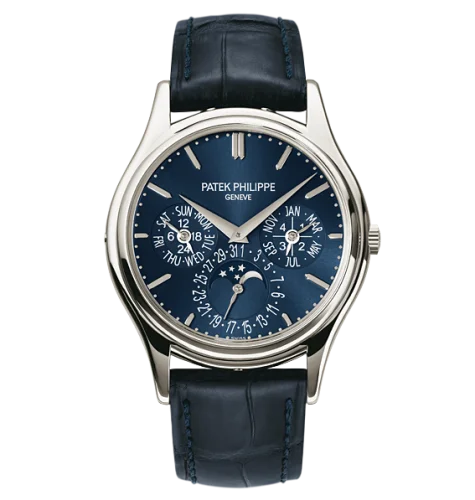
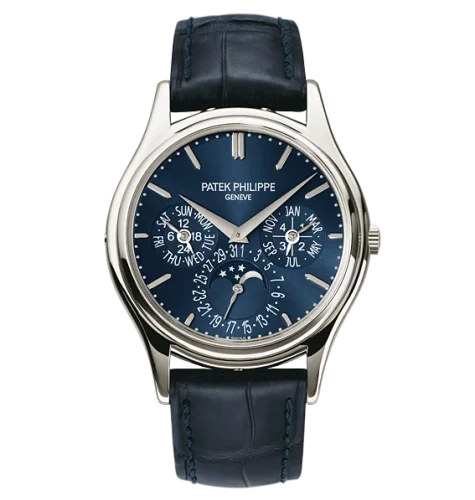

Perpetual Calendar 5140 Platinum Blue
REF. 5140P-001
4/10
UncommonCase
Dial
In Context
At 37.2 mm it sits just under the modern norm — the band that suits the widest spread of wrists. The case back is open, so the movement is visible without taking the watch apart, and the sapphire crystal will resist everything short of deliberate abuse. Rated to 30 m, it is protected against rain and splashes and nothing beyond that.
The movement winds itself from the motion of your wrist. 48 hours of reserve is enough to set it down on Friday evening and find it still running on Monday. At 21,600 vph the seconds hand advances 6 times a second, the slower and more audible rate of an older design.
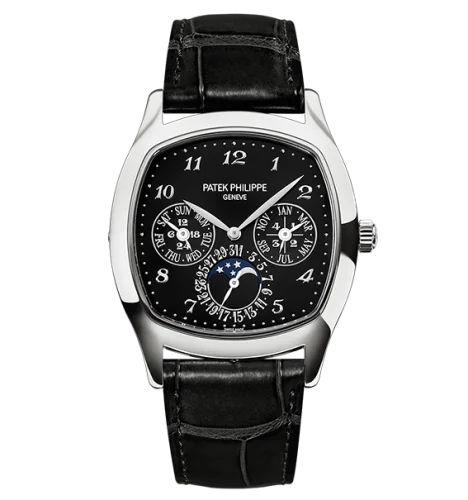
5140P-001 is one of 3 executions of the 5140P base reference. Underneath they are the same watch; what separates this one is a blue dial and a platinum case. Beyond the time it carries a perpetual calendar.
The 5140P family
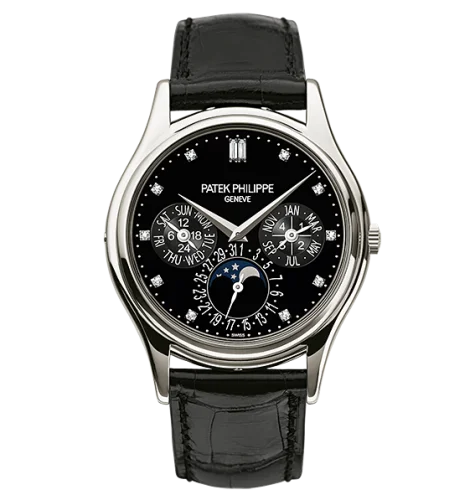
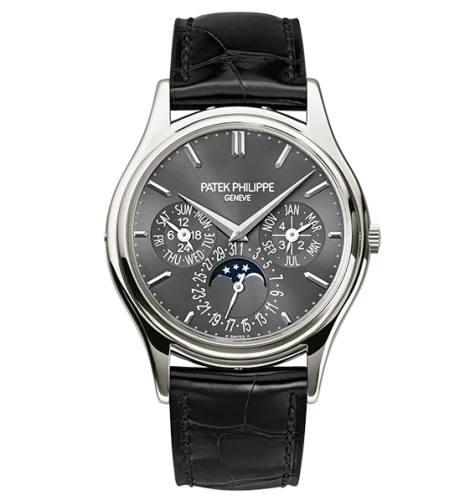
5140P-001 is one of 3 variants sharing the 5140P base reference — same watch underneath, different dial, bezel, or bracelet execution. Browse the others:
Inside: Caliber 240 Q
Explore this caliber →The perpetual calendar built on the 240, and the movement behind Patek's first self-winding perpetual calendar with moon phase — the reference 3940 of 1985. The calendar works sit as a module over the ultra-thin base, and the whole assembly still measures 3.75 mm. Thinness is the point: a perpetual calendar is normally a thick watch, and the 3940 established that it did not have to be.
21 other watches in the library run the Patek Philippe 240 Q.
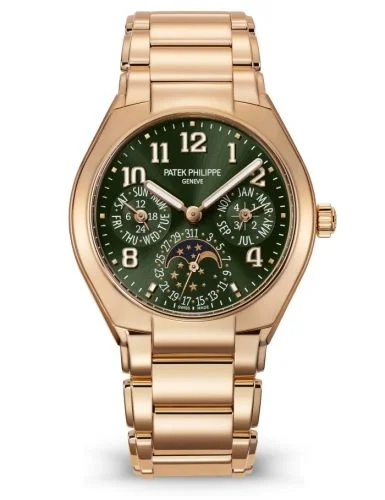
Patek Philippe
Twenty-4 Perpetual Calendar Rose Gold / Green
7340/1R-010 · 36 mm
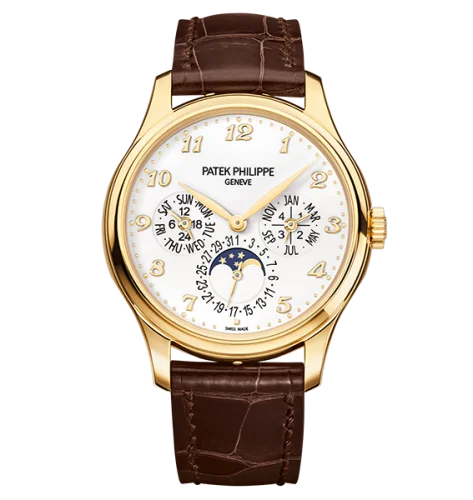
Patek Philippe
Perpetual Calendar 5327 Yellow Gold / Ivory
5327J-001 · 39 mm
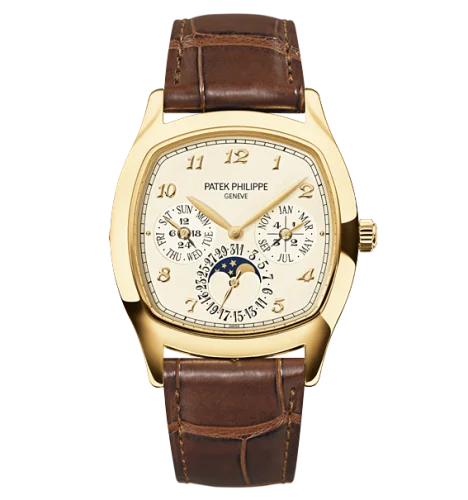
Patek Philippe
Perpetual Calendar 5940J Yellow Gold / Silver
5940J-001 · 37 mm
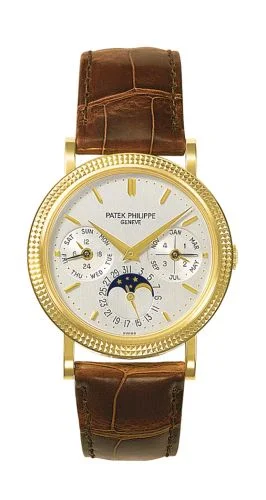
Patek Philippe
Perpetual Calendar 5039 Yellow Gold / Silver
5039J-001 · 36 mm
Similar Watches
Patek Philippe - 7340/1R-010 Twenty-4 Perpetual Calendar Rose Gold / Green
Patek Philippe
Patek Philippe - 5327J-001 Perpetual Calendar 5327 Yellow Gold / Ivory
Patek Philippe
Patek Philippe - 5940J-001 Perpetual Calendar 5940J Yellow Gold / Silver
Patek Philippe
Patek Philippe - 5039J-001 Perpetual Calendar 5039 Yellow Gold / Silver
Patek Philippe
Patek Philippe - 5940G-010 Perpetual Calendar 5940G White Gold / Black
Patek Philippe
Discussion
0 commentsLoading…