


Revolution 20th Anniversary Luminor Marina Destro Carbotech
REF. PAM01708
Case
Dial
In Context
At 44 mm it is a large watch — well above this catalogue’s 40 mm median, and enough to dominate a narrow wrist. At 14.5 mm it is a tall case, and it will catch on a cuff. The case back is open, so the movement is visible without taking the watch apart, and the sapphire crystal will resist everything short of deliberate abuse. 300 m is a professional diving rating, far past any demand a wrist is likely to make of it.
The movement winds itself from the motion of your wrist. 72 hours of reserve puts it well past a weekend — several days off the wrist and it is still going. At 28,800 vph the seconds hand advances 8 times a second.
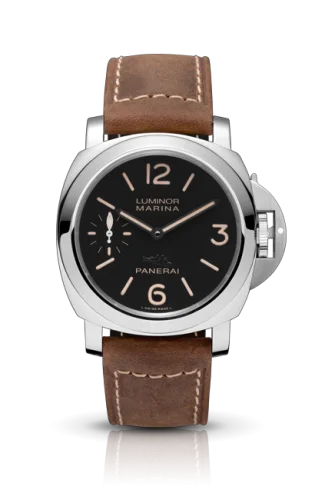
PAM01708 stands on its own in this catalogue — no other reference here shares its base number. It pairs a black matte dial with a titanium, carbotech case. It was a limited edition.
Inside: Caliber P.9010 ND
Explore this caliber →Calibre P.9010 ND is a no-date variant of Panerai’s P.9010 movement, developed and manufactured in Neuchâtel. It maintains the same general architecture as the standard P.9010 while omitting the date mechanism and its display. The calibre indicates central hours and minutes, with small seconds at 9 o’clock. P.9010 ND is an automatic movement featuring two spring barrels, supplying a power reserve of approximately three days. The barrels are wound by a bi-directional oscillating weight. The movement consists of 200 components, including 31 jewels, and measures 13¾ lignes in diameter with a height of approximately 6.0 mm. The balance, mounted beneath a bridge with twin supports, operates at 28,800 vibrations per hour (4 Hz). Recent iterations of the P.9010 family no longer include a stop-seconds (hacking) function and are delivered without decorative finishing. The calibre retains the independent hour-jump adjustment, which enables one-hour increments forward or backward without affecting the minute hand — now functioning independently, without interaction with any date mechanism.

Discussion
0 commentsLoading…